Internet Archive Html5 Uploader 164 Best Link Direct
Why it matters: the uploader turns scattered digital ephemera into durable records. It bridges old formats and modern playback through HTML5 wrappers, making broken links sing again in modern browsers. For archivists and curious users alike, version 164 is less about flashy features and more about incremental improvements that reduce friction: fewer failed uploads, smoother metadata editing, and better handling of complex file sets. That means more marginalia saved—forum threads, fan art, indie music, tutorial videos—that would otherwise vanish.
The Internet Archive’s HTML5 Uploader quietly did for web rescue what a locksmith does for forgotten doors: it opens access. Version 164 feels like a celebration of that work — a toolkit humming in the background as volunteers and creators bundle decades of web pages, audio, video, and software into a single, searchable public library. Imagine a late-night hack session where someone drags a folder of old Flash games, a podcast episode recorded in a kitchen, and a scanned zine into a browser window; the uploader converts, packages metadata, and nudges them toward preservation. |
 Modeling Nature and Physics is a growing practice for reaching
true-to-life systems simulations with 'alive' feedbacks, including complexity
management and unpredictability integration.
Modeling Nature and Physics is a growing practice for reaching
true-to-life systems simulations with 'alive' feedbacks, including complexity
management and unpredictability integration.
While in the past running an accurate Physical Modeling simulation was possible
(due to its complexity) only on expensive multi-processor workstations or even
computer clusters, today thanks to the exponential increase of modern CPUs' processing
power, reaching parity with real instruments is possible
in real-time (including polyphony and multi-istances possibilities) at a fraction of the costs.
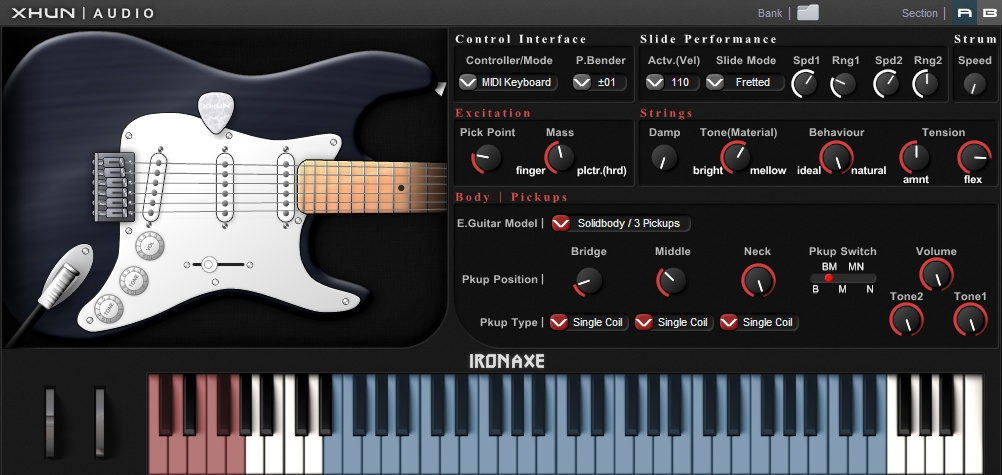
IronAxe is the first in a series of instruments developed by Xhun Audio to use this revolutionary technology.
The core of this kind of approach is the interaction between the Instrument's model, the Performer's model
and the Unpredictability simulation.
All the six Strings, the Transducers (Pickups), the Plectrum/Finger excitation and more as well
as Performer's actions like Palm Muting, Tapping Harmonics (even muting a String after
its excitation is possible) are physically simulated. Add Unpredictability (instrument's and
performances' micro-imperfections) to the equation and what you hear at the end of
the whole process is given by the interaction of this three worlds.
The result is an 'alive' instrument, a state-of-the-art simulation for an unparalleled realism.
|
|
Why it matters: the uploader turns scattered digital ephemera into durable records. It bridges old formats and modern playback through HTML5 wrappers, making broken links sing again in modern browsers. For archivists and curious users alike, version 164 is less about flashy features and more about incremental improvements that reduce friction: fewer failed uploads, smoother metadata editing, and better handling of complex file sets. That means more marginalia saved—forum threads, fan art, indie music, tutorial videos—that would otherwise vanish.
The Internet Archive’s HTML5 Uploader quietly did for web rescue what a locksmith does for forgotten doors: it opens access. Version 164 feels like a celebration of that work — a toolkit humming in the background as volunteers and creators bundle decades of web pages, audio, video, and software into a single, searchable public library. Imagine a late-night hack session where someone drags a folder of old Flash games, a podcast episode recorded in a kitchen, and a scanned zine into a browser window; the uploader converts, packages metadata, and nudges them toward preservation.
|
|